In shortApollo Bay sits at the midpoint of the Great Ocean Road, roughly where day tours break for lunch. Give it the beach and the harbour foreshore, the regional visitor information centre at 100 Great Ocean Road, and a drive up into the Otway forest behind town. Walkers treat the town as a trailhead: the track west to the Twelve Apostles leaves from here, more than 100 kilometres of coast that most people cover in eight days.
1300 689 297phone for the visitor information centre in town
100+ kmof track leaving town westward for the Twelve Apostles
8 daysusual time to walk it, east to west
2:30pmwhen many cafes along the route stop serving
Apollo Bay things to do in half a day
Apollo Bay is the midpoint of the Great Ocean Road and the stop where most one-day runs from Melbourne break for food. The town reads clearly from the car: one main street along the water, a long open beach in front of it, the harbour at the southern end, steep green hills rising straight behind the shops. An hour covers the foreshore and lunch. Half a day adds the hill above town and a short run into the forest.
Start at the information centre. It stands on the foreshore at 100 Great Ocean Road, Apollo Bay VIC 3233, it covers the whole region rather than just the town, and the number is 1300 689 297. Opening hours are not stated on the official regional page, so call before you build an afternoon around it. Eat early as well: cafes and bakeries along this coast often stop serving by 2:30pm, and Apollo Bay is one of the two reliable meal towns on the route, so a 1pm arrival is the last comfortable one.
- Walk the foreshore reserve between the surf beach and the harbour, flat and open the whole way.
- Spend time at the harbour at the southern end, where the fishing fleet ties up behind the breakwater.
- Take the hill road behind the main street for the view back down over the bay.
- Buy lunch before 2:30pm, and something to carry for the afternoon.
- Ask at the information centre which Otway tracks are open on your date; closures here change often.
- Drive inland on the forest roads for an hour if the time is there, then come back down to the coast.
The full-coast day that stops here
Fourteen hours out of Melbourne, from $112, with Apollo Bay as the lunch break: selected hotel pickup, WiFi on board, national park fees and a coffee or tea on the way, and cancellation at no cost up to 24 hours before departure.
★ 4.9/5 · 7,098 reviews
Apollo Bay harbour, the foreshore and the lookout above town
The harbour is the part of town that still works for a living. Boats come and go behind the breakwater, the water inside stays flat when the beach outside is not, and the walk out along the wall gives you the whole arc of the bay in one look. North of it the beach runs long and straight past the grassed foreshore, which is where the town keeps its playground, picnic tables and market space.
Behind the shops the land goes up sharply, and that is where the view is. The roads climbing the hill lead into open paddock country with the bay, the harbour and the sweep of the coast below you, and late afternoon light suits it better than midday. Bring a windproof layer whatever the forecast says. The nearest long-record weather station, at Cape Otway lighthouse, measures its strongest mean winds in August at 27.6 km/h at both 9am and 3pm.
Birds wash up on a beach this long, and an H5 bird flu warning currently applies across the parks on this coast. Leave any sick or dead animal where it lies, keep children away from it, and pass the sighting to the Emergency Animal Disease Hotline on 1800 675 888.
Breaking the narrow stretch either side of town
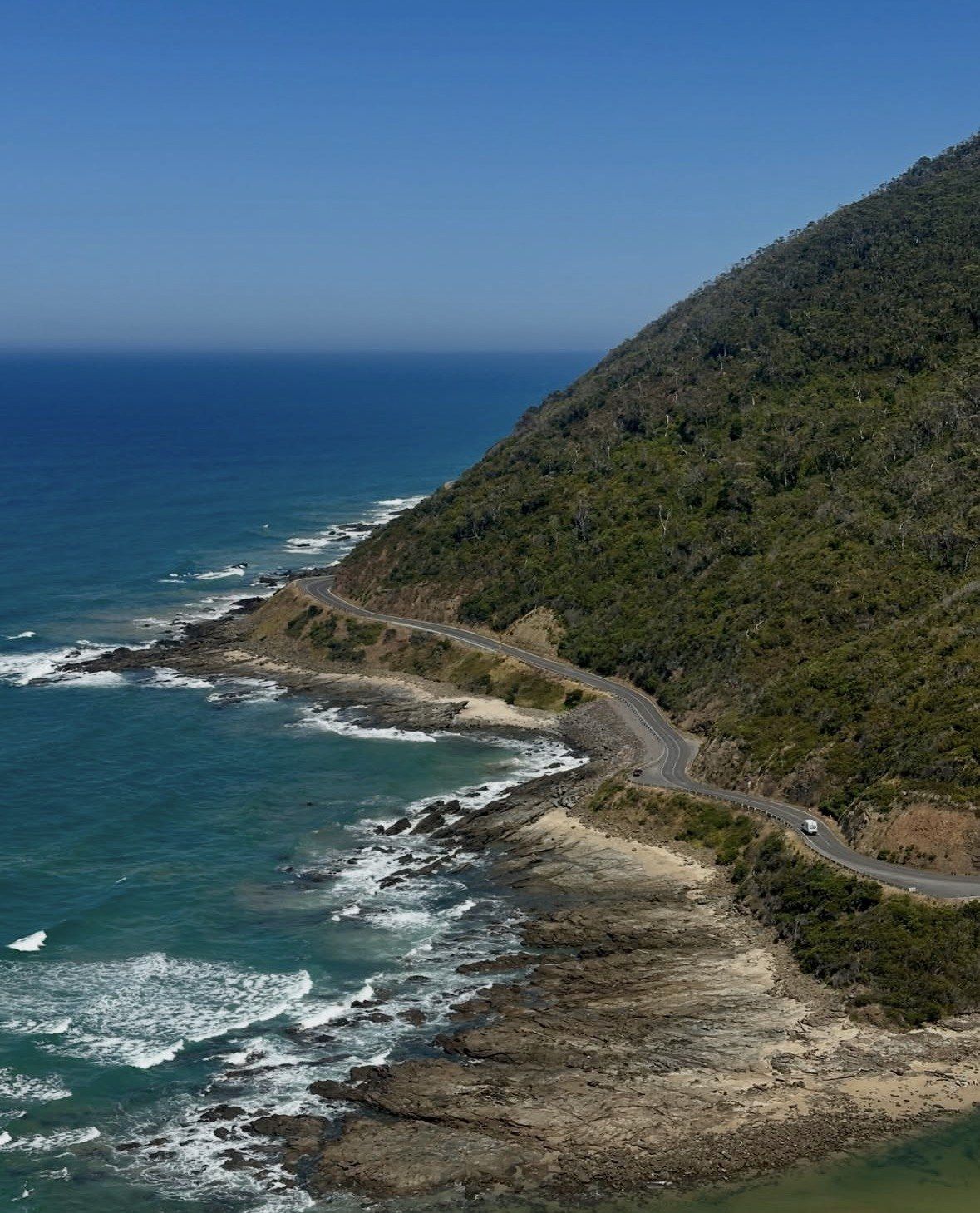
The road between Lorne and Apollo Bay is narrow, winding and slow, and the official regional advice is to avoid driving it at night and to stop every 45 to 60 minutes. Build those stops in rather than pushing through, and use the town as one of them in either direction. Australia drives on the left, drivers are asked to pull into the slow-vehicle turnouts so they do not hold up traffic, and stopping for photographs on blind corners or across private driveways is prohibited.
Kennett River sits halfway between Lorne and Apollo Bay and is the usual koala stop on this stretch, with Grey River Road named by the land manager as the main wildlife-viewing spot. Stand on a walking trail or in a designated viewing area rather than on the verge, and keep your food to yourself. The Authority, which works under the Wildlife Act 1975, sets out what hand-feeding does: animals stop foraging for themselves, crowd together in unnatural numbers that pass disease around, develop dietary deficiencies and start behaving aggressively. Parking in the precinct is limited under the adopted plan, and large tour coaches are not permitted to enter or stop within it.
West of town the road turns inland over the Otways before it comes back to the cliffs. The regional tourism body advises against covering the whole road in a single day and suggests at least two or three, which is the argument for sleeping here or at Lorne instead of driving back to Melbourne in the dark. Mobile reception is unreliable along the route, so download your maps and accommodation details before you leave town.
Into the forest and out to the cape
Cape Otway Lightstation is the detour most people make from here. What you walk around is the grounds and the outside of an 1848 tower that stands 90 metres above the water and remains the oldest surviving lighthouse on mainland Australia; heritage conservation works have it shut, with no climbs and no access inside. Days of the week matter more than times at this one: Friday to Tuesday, 9:30am to 4:30pm, nobody let in after 4pm, closed on Christmas Day. Check the day before you drive out, because a Wednesday or Thursday itinerary built around it falls apart.
The other inland option is Otway Fly, where a 600-metre steel walkway is carried through the canopy between 25 and 30 metres above the rainforest floor. It runs daily from 9am to 5pm apart from Christmas Day, and the gate stops admitting at 3:30pm. The guided zipline takes you up to 30 metres above the forest over 2.5 hours and should be booked ahead, because the operator warns that spaces may not be available if you simply turn up. Put it in the morning and keep the coast for the afternoon, since that 3:30pm cut-off closes the door on the opposite order.
Check the waterfall walks behind the coast before you set out. As at November 2026, five of them were down as temporarily closed: Erskine Falls, Phantom Falls, Won Wondah and Henderson Falls, St Georges River Loop and Cora Lynn Cascades. Flood damage from January still has Kennet Road and the Kennet-Wye Jeep Track shut near Kennett River, and Wye Road carries no reopening date. The walk that was open on that side is the Wye to Kennett River track: 4.6 km one way, undulating, with steps and creek crossings, beginning at the top of Morely Avenue beside the Wye River hotel and ending in Kennett River township. The Authority's general enquiry line is 1300 736 533.
Where the Great Ocean Walk starts
For walkers this town is a trailhead. The Great Ocean Walk runs more than 100 kilometres from Apollo Bay to the Twelve Apostles, is usually completed over eight days, and is laid out to be walked east to west, from here toward the Apostles, because both the views and the gradients work better in that direction. Arrive the evening before and you can be on the track early on day one.
The planning happens months out. Seven hike-in campsites take a maximum of three guests each, every one must be reserved before you walk, and the booking is your camping permit; reservations for the Authority's park sites are made online. Long-distance walkers, groups and tour operators are asked to register their itinerary at least 14 days before setting out, and some beach and river sections become unsafe at high tide or in rough surf, so tide times go into the plan alongside the campsite dates.
For one day on the track instead of eight, walk a single stage out of town and arrange a lift back, or pick a stage near the western end. Walkers who finish at the Twelve Apostles need the same reservation as drivers: since 16 October 2026 a booking has covered the whole precinct, the car park and the lookouts included, rather than the visitor centre alone.
Which tours stop here for lunch
Every day tour on this site runs through Apollo Bay, and none of them includes lunch, so the meal is bought in town during the stop the driver gives you. The early closing pattern matters more on a tour than in a car: the stop happens when the vehicle stops, so take something for the afternoon while you are already at the counter.
The 14-hour small-group eco day from $112 covers the most of the route in one run, with pickup from selected hotels, WiFi on board, national park fees and coffee or tea listed as included, and it carries by far the largest number of reviews of any tour here. The 12-hour premium coach from $63 takes the route in the opposite order, so the Apostles come early and the coast road comes in the afternoon; ask the operator where the Apollo Bay stop falls on that schedule. The 11-hour minivan day from $181 is the shortest on offer and meets at the entrance of the Mercure Melbourne Southbank, which suits anyone who would rather not spend fourteen hours in a seat. Cancellation works the same way on all three: pull out 24 hours or more before departure and you get the whole fare back.
| Tour | Duration | From | Meeting point | Food listed | Best for |
|---|
| Great Ocean Road Small-Group Eco Tour from Melbourne | 14 hours | from $112 | Pickup from selected hotels | Coffee and/or tea; meals not included | Seeing the most of the route in one day |
|---|
| Great Ocean Road TOUR & 12 Apostles Tour Reverse-In Premium BUS | 12 hours | from $63 | 400 Flinders St, outside the Immigration Museum building | Bottled water; lunch not included | Reaching the Apostles ahead of the midday peak |
|---|
| Small-Group Great Ocean Road Day Trip from Melbourne | 11 hours | from $181 | Entrance of Mercure Melbourne Southbank | None stated | The shortest day, in a small air-conditioned minivan |
|---|
Questions people ask
Is Apollo Bay a good place to stay the night?
It is one of the two obvious overnight towns on the eastern half of the road, and the regional tourism body advises spreading the drive over at least two or three days. A night here means you drive the narrow Lorne stretch in daylight and reach the Shipwreck Coast early the next morning. For December or January, arrange a room months ahead; Victorian school summer holidays run from 21 December 2026 to 27 January 2027, the busiest window of the year.
What can I expect from the weather?
The gauge in town puts January afternoons at a mean maximum of 21.9 °C and July ones at 13.1 °C, with nights averaging 13.9 °C and 7.3 °C. Rain totals 1060.0 mm a year across 127.1 rain days, so a passing shower during a long day out is normal here. The wet sits in late winter: 126.2 mm falls in an average August, against 49.3 mm in February. Pack a shell and a warm layer in any season.
What should I book before I arrive?
Book Twelve Apostles entry first if the Apostles are part of your trip, because a booking has been compulsory for the car park and the lookouts as well as the visitor centre since 16 October 2026. Book the Otway Fly zipline ahead, since walk-up spaces may not exist. Great Ocean Walk campsites must be reserved before you set out, and the reservation doubles as your camping permit.
Will my phone work along this part of the road?
Expect gaps. Coverage on the Great Ocean Road comes and goes, and travellers are told to pull their maps and accommodation details onto the phone before driving out of town. Save your booking confirmations as screenshots instead of links you have to load. The information centre on the foreshore at 100 Great Ocean Road is the place to collect paper details for the stretch west of town; the number is 1300 689 297.
Can I take a dog to the sights near Apollo Bay?
The headline sights west of here are closed to dogs: none at the Twelve Apostles, none at Loch Ard Gorge, and none anywhere in Port Campbell National Park, while Tower Hill accepts assistance dogs only. Plan the day around that if you are travelling with a dog, and check the current rules for the beaches and reserves you intend to use, because management arrangements along this coast changed through 2026.
Read also